
Review · HOT SPRINGS WITH LUNCH
Auckland: Rotorua Māori Cultural & Geothermal Tour & Lunch
Rotorua packs fire, food, and ceremony into one day. This 13-hour trip from Auckland combines a traditional Māori welcome and hangi lunch at Mitai Māori Village with the strange, colorful volcanic features of Wai-O-Tapu Thermal Wonderland. I especially like the mix of living cultural performance and natural science, plus the small-group minibus setting with hotel pickup, onboard water, refreshments, and Wi-Fi.
The strongest moments are the warrior canoe display on Wai-o-Whiro stream and the walk past Champagne Pool, bubbling mud, and steaming ground. Guides such as Karthik have also earned praise for keeping the long day friendly and well paced. The main consideration is time: you spend many hours on the road, and the village presentation is a staged cultural experience rather than a permanently inhabited Māori settlement.
Key points to know before booking
- Two major Rotorua experiences in one day: You combine Mitai Māori Village and Wai-O-Tapu without arranging separate transport from Auckland.
- A real hangi meal: Food is cooked in baskets over hot stones in an earth oven, giving lunch a distinct smoky, earthy character.
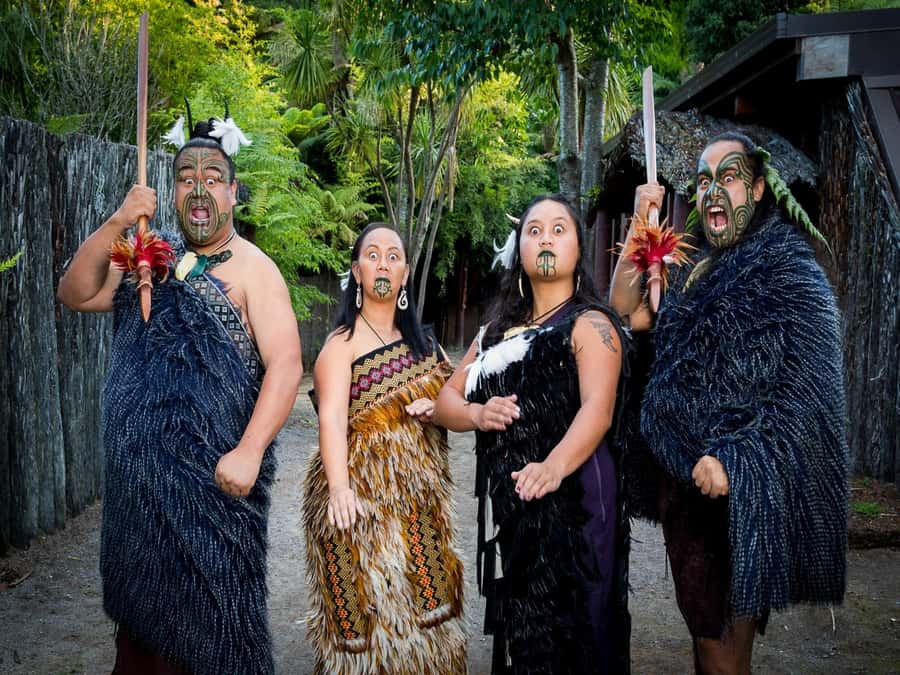
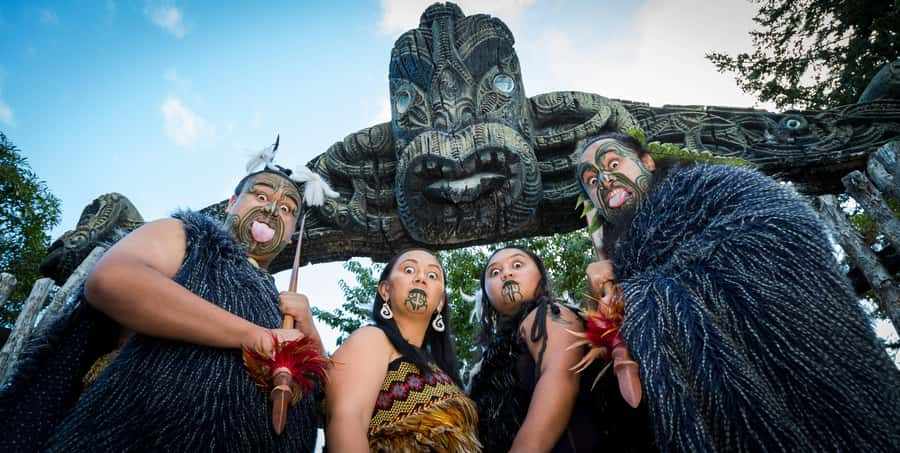
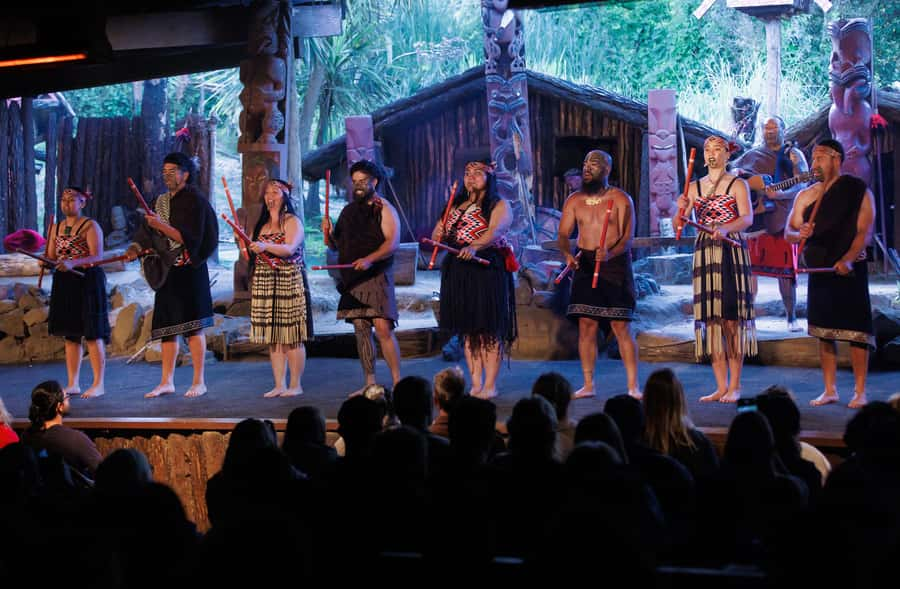
- Warrior canoe and haka: The cultural program includes a pōwhiri, waiata, mōteatea, poi, haka, weapon displays, and ta moko explanations.
- A 45 to 90 minute geothermal walk: Wai-O-Tapu gives you time to see Champagne Pool, Devil’s Bath, hot springs, craters, mud, and sinter terraces.
- Small-group transport: The minibus carries a small group, with a live English-speaking escort throughout the day.
- A demanding but rewarding schedule: Comfortable shoes, sun protection, a jacket, and a willingness to walk on uneven ground are essential.
The long road from Auckland to Rotorua
Your day begins with pickup in Auckland CBD. You need to be at the meeting point 10 minutes early, since the minibus cannot wait for late passengers and missed departures are not refunded. Look for a vehicle marked with the registration number provided at booking, such as KYQ418, or the TOURME identifier.
The drive south passes through the Waikato region, where open farm country, mountains, and grazing animals provide the first change of scenery. This is not a quick shuttle. The full outing lasts 13 hours, so the countryside drive forms a substantial part of your day.
I see that as both a strength and a cost. If you want to reach Rotorua from Auckland without renting a car, the drive saves you the work of navigating and parking. Your escort can also point out features along the route and answer questions. On the other hand, you should not book this expecting a relaxed half-day outing. It is a full day with two substantial stops and a long return journey.
The temperature-controlled minibus makes the road time easier. Water, refreshments, and high-speed internet are included, useful touches when you are away from Auckland for so long. One particularly helpful detail is the planned rest-stop rhythm. Deborah, an older participant, appreciated having time to pause during the day, which matters when the schedule is full.
More Hot Springs with Lunch in New Zealand:
- Lake Rotoiti Evening Kayak Tour including Hot Springs, Glowworm Caves and BBQ Dinner
★ 5.0 · 60 reviews - Hot Pools Kayak & Evening Barbecue
★ 5.0 · 12 reviews - Antalya Pamukkale Hot Springs & Hierapolis Tour With Lunch
★ 5.0 · 1,092 reviews
Mitai Māori Village: ceremony before lunch
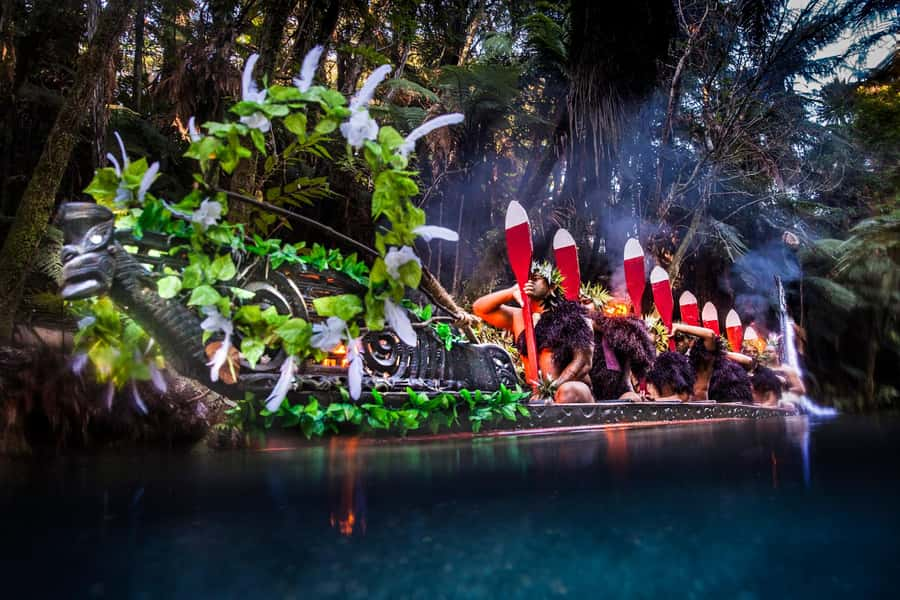
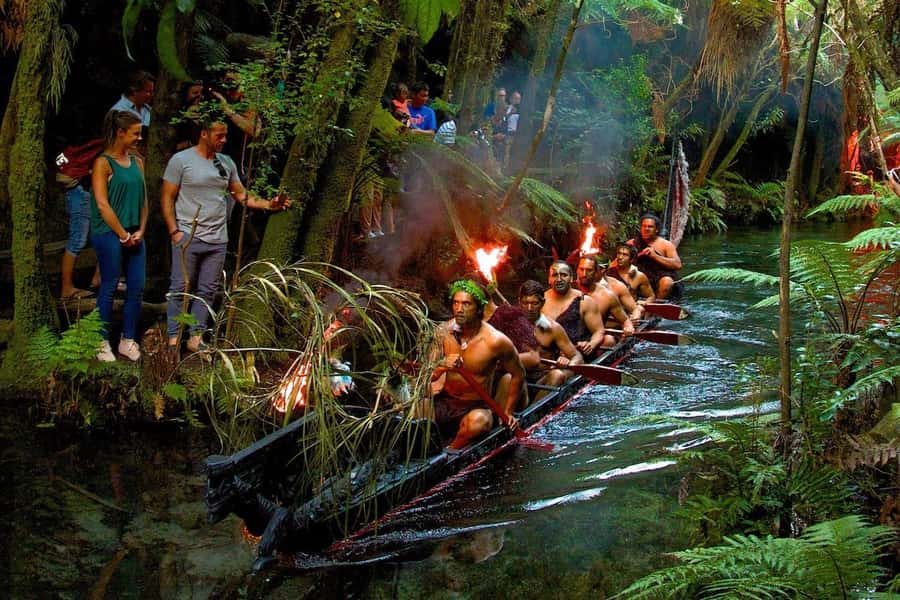
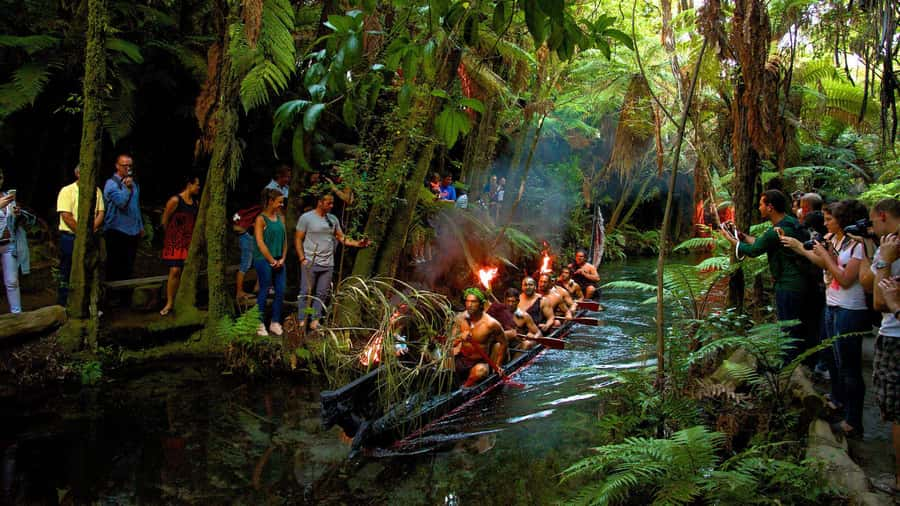
Mitai Māori Village provides the cultural heart of the outing. The experience begins with a traditional welcome, known as a pōwhiri, followed by songs, chants, dance, and displays of Māori weaponry. You see a warrior canoe move along the Wai-o-Whiro stream, an image that gives the ceremony a strong sense of place.
The program includes a wero, or ceremonial challenge, as well as waiata, mōteatea, poi, and haka. These are not simply disconnected stage acts. Together, they show different parts of Māori performance, from song and rhythm to formal welcome and displays of strength.
The haka is likely to be the most familiar element, but it is worth paying attention to the quieter sections too. The chants and explanations of carving, ta moko, and traditional weapons give the performance more context. You get a better sense of how art, identity, ceremony, and defense fit together in Māori culture.
The warrior canoe display adds a strong visual moment. The boat glides along calm water while the performers present themselves as fierce defenders. It is a simple setting, but the combination of movement, facial expression, chanting, and water creates real drama.
The cultural program is performed for visitors, and the village is not a continuously inhabited settlement. That distinction matters. You are seeing a carefully presented cultural show, not dropping into an ordinary Māori neighborhood or witnessing daily life. For some people, that staged quality will feel a little polished or theatrical. For others, it offers a clear, accessible introduction, especially if you have limited time in New Zealand.
Hangi lunch and the taste of the earth oven
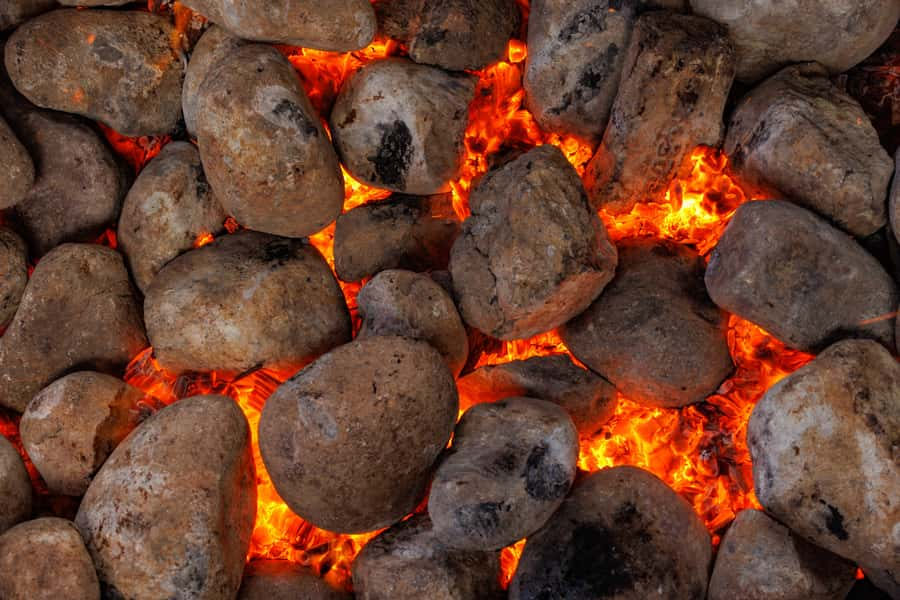
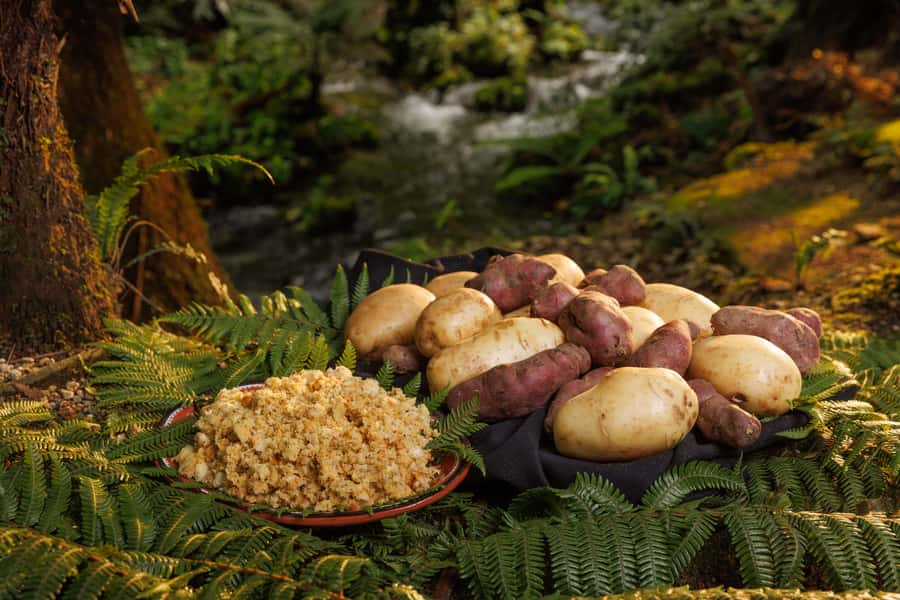
Lunch is a traditional hangi buffet. In this cooking method, food is placed in baskets on heated stones at the bottom of a pit roughly one to two meters deep. The earth oven gives the meal its distinctive preparation and flavor.
I like that lunch is tied directly to the cultural visit rather than being an unrelated restaurant stop. The meal helps explain Māori food traditions in a practical way, and it gives you time to sit down after the performance.
Food quality has been a major strength of the day. Rebecca described the meal as one of the best parts of the experience, and Ana Maria also enjoyed the food. Still, Ana Maria felt that the serving dishes did not always look as clean as expected. That is a small but fair caution for anyone with high standards around buffet presentation.
Dietary planning needs care. Some requests may be met, but the provider cannot accommodate every diet, and vegan choices are not guaranteed because of the nature of the Māori kai. If food restrictions are important to you, ask before booking rather than assuming the buffet can be adapted.
Wai-O-Tapu and the colors of volcanic New Zealand
The second major stop is Wai-O-Tapu Thermal Wonderland, one of the North Island’s most varied geothermal areas. Here, the ground is active, colorful, and often steaming. You follow self-guided paths through a bush setting, with walks that generally take 45 to 90 minutes.
The site gives you a very different kind of experience from Mitai. At the village, people, sound, and ceremony lead the visit. At Wai-O-Tapu, the main attraction is the earth itself: hot water, mineral deposits, mud, vapor, and enormous volcanic craters.
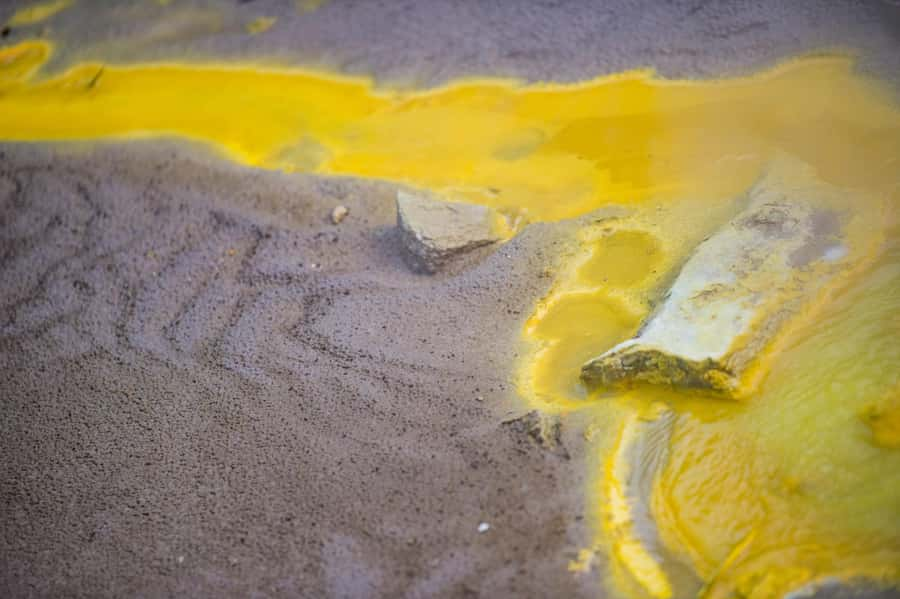
The Champagne Pool is the headline feature. Its name comes from the constant bubbling at the surface, caused by carbon dioxide escaping from the hot water. Naturally colored springs add bright shades to the walk, while Devil’s Bath is known for its striking color. The exact appearance can vary with light and conditions, so keep your camera ready rather than expecting one fixed postcard view.
You also pass bubbling mud, steaming ground, broad craters, and sinter terrace formations. Some features are subtle from a distance, while others are immediately dramatic. The point is not to rush from one attraction to the next. Give yourself time to read the signs, look closely at the colors, and notice how mineral deposits shape the ground.
The paths include unpaved and uneven sections. You need to climb and descend stairs, and sturdy shoes are strongly recommended. Jandals, flip-flops, sandals, and high heels are unsuitable. This is an easy walk for people with a reasonable fitness level, but it is not suitable for wheelchair users or anyone who cannot manage uneven ground.
Do not touch the plants or stray from the marked areas. This is an active geothermal site, and the rules protect both you and the fragile environment.
A few more places to soak around New Zealand worth a look
- Rotorua: Wai-O-Tapu Geothermal Park Entry Ticket
★ 4.6 · 2,601 reviews - Rotorua: Hell’s Gate Outdoor Mud Spa & Guided Walk
★ 4.7 · 1,140 reviews - Rotorua Rafting: Kaituna River Rafting Experience-Free Sauna
★ 4.9 · 401 reviews - Polynesian Spa Rotorua: Deluxe Lake Spa Hot Spring Bathing
★ 4.5 · 358 reviews
Why the small-group format helps
The minibus format is one of this experience’s practical advantages. You avoid arranging a rental car, finding Rotorua parking, and working out the route between Auckland, Mitai, and Wai-O-Tapu. Pickup and return to Auckland CBD are included, as are refreshments and water.
A small group also makes conversation easier. The guide can answer questions during the road sections and help keep the day moving. Karthik received especially strong praise for his friendly manner, clear information about New Zealand, patience with questions, and ability to maintain a good pace. One participant noted that he was also attentive to rest breaks.
The exact group size can vary, but at least one February departure had six people in the small group before joining other groups for the cultural performance and meal. That arrangement is worth understanding. Your transport group may feel intimate, while the actual show and buffet can be shared with a larger audience.
The live guide speaks English. If you want a tour with extensive commentary throughout every minute, this should suit you. If you prefer complete independence, the Wai-O-Tapu portion offers some freedom through its self-guided walking time.
Is $264 good value for a 13-hour day?
At $264 per person, this is not a cheap Auckland day trip. The value depends on how much you want to pack into one outing and how much you value convenience.
The price covers return transport from Auckland, a dedicated English-speaking escort, admission to the Mitai cultural program, the haka and warrior canoe presentation, the hangi buffet lunch, and entry to Wai-O-Tapu. You also receive water, refreshments, Wi-Fi, and temperature-controlled transport.
Buying each element separately would require transport planning and a long day of driving. The tour is therefore strongest for you if Rotorua is a priority but you are staying in Auckland and do not want to rent a car. It also makes sense if you have only one free day and want both Māori culture and geothermal scenery.
The value is weaker if you already have several days in Rotorua. In that case, you could stay locally, spend more time at each attraction, and avoid the long return drive. You might also prefer a tour focused only on Māori culture or only on geothermal sites.
A small detail affects the value too: Wai-O-Tapu is self-guided, while the Mitai visit is the fully guided portion. If you are paying mainly for expert interpretation at every stop, note that the geothermal visit gives you more independent time.
Who will enjoy this day most?
I would recommend this trip to first-time visitors who want a broad introduction to the central North Island without building a complicated itinerary. Families can benefit from the variety, since the day alternates between performance, food, scenery, and unusual natural features. The experience is described as suitable for all ages, provided participants can walk and manage stairs.
It also suits people who enjoy strong contrasts. You begin with farmland and mountain views, move into a Māori cultural setting, then finish among craters, hot springs, and colored pools. The changes keep the day from feeling like one long museum visit.
You should think twice if you have back or heart problems, are pregnant, use a wheelchair, or find long road days tiring. The tour operates in all weather, so rain or cool conditions can affect your comfort. Bring a jacket or warm layer, sun protection, a hat, and water, even if Auckland begins the morning under mild skies.
Photography is encouraged, and Wai-O-Tapu in particular offers plenty of striking subjects. Protect your phone or camera from rain and keep it ready during the countryside drive, where farm animals and mountain views may appear between stops.
Timing, comfort, and a few useful cautions
This is a tightly planned day. One Māori guide spoke longer than planned on one departure, putting the group slightly behind schedule. That is not necessarily a flaw, since good cultural explanation takes time, but it shows that the timing can shift.
Wear comfortable clothing that works in sun, wind, or rain. The geothermal paths can feel exposed in places, while the minibus provides a controlled temperature between stops. Comfortable walking shoes matter more than stylish footwear here.
Cancellation is free up to 24 hours before departure. The trip requires a minimum number of participants, so if that number is not reached, you would be offered another date, another experience, or a full refund. Personal expenses are not included.
Should you book the Auckland to Rotorua day trip?
Book it if you want the efficient version of Rotorua: one cultural program, one hangi lunch, one geothermal park, and transport from Auckland handled for you. The strongest reasons are the Māori performance, the warrior canoe, the unusual food preparation, and Wai-O-Tapu’s range of volcanic features. Guides such as Karthik can make the long road sections far more useful and comfortable.
Skip it if you want a slow Rotorua stay, a fully independent day, or a cultural experience that feels less staged. Also skip it if uneven paths, stairs, or a 13-hour schedule would be hard on you.
For most first-time visitors with one free day, the combination is sensible and well balanced. You will spend plenty of time on the road, but you come away with two very different views of the region: one shaped by Māori ceremony and hospitality, the other by heat, minerals, and volcanic force.
FAQ
How long does the Auckland to Rotorua tour last?
The experience lasts 13 hours, including the return journey between Auckland and Rotorua.
Is pickup from Auckland included?
Yes. Pickup and drop-off from Auckland CBD are included, with transport provided in a temperature-controlled minibus.
What food is served at lunch?
The meal is a traditional hangi buffet. Food is cooked in baskets over hot stones in an earth oven.
Is the geothermal walk guided?
Wai-O-Tapu includes a self-guided walk lasting about 45 to 90 minutes. A local English-speaking escort remains with the group during the wider tour.
What should I wear and bring?
Wear sturdy, comfortable shoes and clothing suited to changing weather. Bring a hat, sunscreen, a camera, and water. A jacket or warm layer is also recommended.
Is the tour suitable for wheelchair users?
No. The tour requires walking on uneven or unpaved ground and climbing and descending stairs. It is also not suitable for pregnant women or people with back or heart problems.
Just added around New Zealand
- Whakarewarewa: Self-Guided Geothermal Trails★ 4.5 · 41 reviews
- West Auckland: Sunset with Thermal pool & Wine Tasting★ 5.0 · 3 reviews
- WAI-O-TAPU Geothermal, Rotorua – Group Day Tour Ex Auckland★ 4.3 · 4 reviews
- Te Puia Geothermal, Kiwi and Māori Art★ 3.5 · 3 reviews
- Wai-O-Tapu Geothermal Valley, & Hot River★ 5.0 · 4 reviews
- Hells Gate Geothermal, Mud & Sulphur Spa★ 4.0 · 7 reviews
- Private, via beaches, Kiwi farm to Rotorua 8 lakes & Geothermal★ 5.0 · 20 reviews
- Waimangu Geothermal Valley & Lake Rotomahana Tour – 7hrs★ 5.0 · 32 reviews
Hot Springs with Lunch, compared.
Antalya Pamukkale Hot Springs & Hierapolis Tour With Lunch
Read our review →
Furnas: Night-Time Experience with Thermal baths and Dinner
Read our review →
Active Volcano, Rice Field, Hot Spring, Fruit market, Tea Plantation with Lunch
Read our review →
White Crater Hotspring Tea Plans And Lunch Included
Read our review →
Private Golden Circle, Sky Lagoon and Friðheimar Greenhouse Lunch
Read our review →Furnas Night-Time Experience with Thermal baths and Dinner
Read our review →
Hoover Dam & Hot Springs Kayak Tour with Lunch & Expert Guide
Read our review →
Batu Caves,Waterfalls and Hot Springs Tour With Lunch
Read our review →Browse the lists this tour appears in